Why Your Brain Creates Problems That Don’t Exist (And How to Stop the Spiral)
Apr 29, 2026You send a text…and the reply doesn't come. Ten minutes later, your mind has already built a story. She's upset. I said the wrong thing. Something's wrong.
That jump from small fact to big fear feels personal, but it usually isn't. Your brain is trying to protect you, not wreck your peace. The trouble is that old survival wiring often reacts before real evidence shows up.
Once you see that pattern, everyday worry starts to make more sense.
The brain is built to look for danger, even when there is none
Your brain is not neutral. It doesn't wake up each morning asking, "What is most likely?" It asks, "What could hurt us?"
That made sense when human life involved real physical danger. A brain that noticed the snake in the grass faster than the flowers had an edge. In modern life, the "snake" is often a delayed email, a tense tone, or a strange body sensation. Yet the alarm system still fires.
This is why a normal day can feel heavier than it is. The brain often scans for threat before facts. It fills the room with smoke before it checks for fire.
Recent research summarized in early 2026 keeps pointing to the same truth. Negativity bias is a built-in survival trait, and the brain gives bad news more attention than good news. The hopeful part is that the brain also changes with practice. That means the pattern is strong, but it isn't fixed forever.
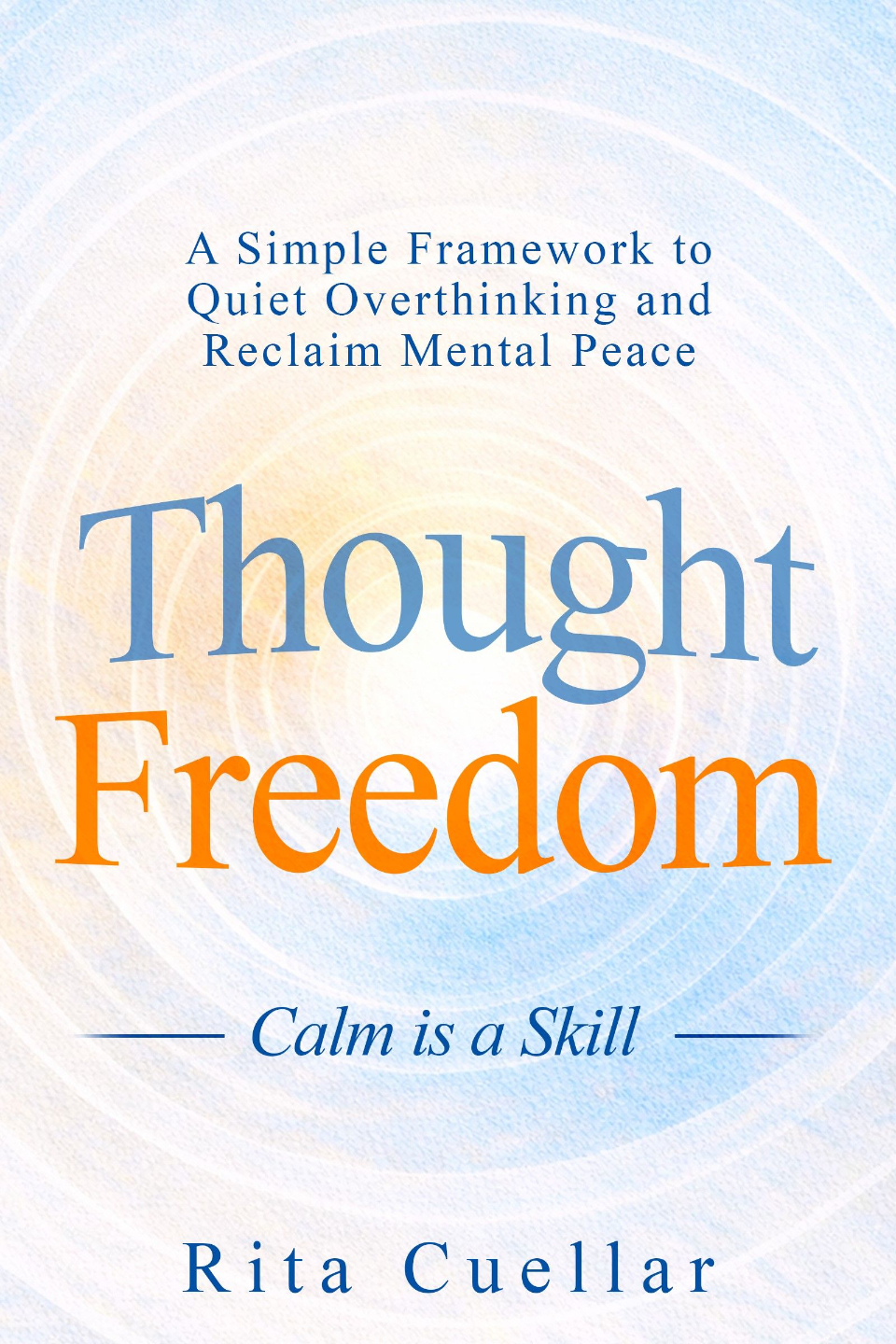
If this pattern feels familiar, I put together a simple Thought Freedom Starter Kit to help you break it. You can get it here.
Negativity bias makes bad news feel bigger than good news
Most people don't remember ten calm moments as clearly as one awkward one. That's negativity bias.
If your boss says, "Great work, but fix slide six," many minds cling to slide six. If a friend sends a short reply, your brain may hear coldness that isn't there. Meanwhile, yesterday's warm conversation fades into the background.
This doesn't mean you're pessimistic. It means your brain gives extra weight to possible problems. Healthline's explanation of negativity bias lays out how negative experiences often stick longer and hit harder than positive ones.
So when your mind zooms in on what went wrong, it isn't giving you a balanced report. It's giving you a threat-focused one.
If you’ve noticed your mind getting stuck like this, you might also relate to why you feel mentally exhausted even when you rest.
Your nervous system treats uncertainty like a warning sign
Unclear situations are hard on the nervous system. When you don't know what something means, your brain often fills the gap with fear.
A mammogram follow-up call can become a health crisis in your head before you know the facts. A partner's quiet mood can turn into "something is wrong with us." A change in your body can start a spiral before you even finish your coffee.
Uncertainty feels unsafe because your brain likes prediction. If it can't predict, it often prepares for the worst. That preparation can feel useful, but it usually creates pain before there is proof.
The brain would often rather create a false alarm than risk missing a real threat.
That made sense for survival. It doesn't always help you at 2:00 a.m.
How normal thoughts turn into fake problems
Most fake problems don't arrive fully formed. They build fast, step by step.
First, something small happens. Then your brain attaches meaning to it. Next, your body reacts as if the story is true. After that, the physical stress makes the story feel even more convincing.
A missed call becomes bad news. A typo becomes proof you're slipping. A headache becomes a sign that something serious is wrong. The mind can move from fact to fiction in seconds.
Catastrophizing turns small issues into worst-case stories
Catastrophizing is when the mind jumps straight to disaster. It takes a small unknown and turns it into a final verdict.
A simple example: your doctor asks you to come in and discuss lab results. Before the appointment, your mind writes a full script. It must be serious. My life is about to change. I won't be able to handle it.
Or maybe you make a mistake in a meeting. Instead of seeing one mistake, you see a chain reaction. People noticed. My reputation is damaged. I'm losing my edge.
This kind of thinking feels urgent because it creates the illusion of control. If you predict the worst, maybe you'll be ready. But Cleveland Clinic's guide to catastrophizing explains that this pattern distorts reality and can intensify both emotional and physical stress.
The problem is not caution. The problem is when caution turns into a story with no evidence behind it.
This is also why many women struggle to make decisions without second-guessing.
Rumination keeps the brain stuck on the same fear
Rumination feels productive because you're "thinking about it." But most of the time, you're circling, not solving.
You replay the conversation in the car. Then again in the shower. Later, you revisit it in bed, looking for the exact line where things went wrong. Hours pass, yet nothing gets clearer.
This is one reason smart, capable women get trapped in worry. A strong mind can generate endless analysis. That skill helps at work. It does not always help when fear takes the wheel.
Research on rumination has found that repeated negative thinking can prolong low mood, interfere with problem-solving, and keep the stress response active. This PubMed review on rumination describes how the cycle can magnify distress instead of resolving it.
Useful thinking leads somewhere. Rumination keeps you on a treadmill.
This is similar to what happens when you keep replaying conversations in your head.
This is exactly the kind of loop I walk you through step-by-step inside the free Starter Kit.
Stress can make imaginary problems feel physically real
Once your brain believes danger may be near, your body joins in. Your heart races. Your chest tightens. Your stomach flips. You get tired, wired, foggy, or headachy.
Then a second fear appears: if I feel this bad, something must be wrong.
That is one of anxiety's cruel tricks. A thought creates stress. Stress creates symptoms. Then those symptoms seem to confirm the thought. Suddenly the imagined problem feels real because your body is reacting in real time.
This is why fake problems can feel so convincing. The body doesn't wait for a courtroom of facts. It responds to the alarm signal.
So if you feel shaky, tense, or drained, pause before you assume the worst. Sometimes your nervous system is reacting to a story, not an event.
Why this pattern shows up so often in midlife
Midlife often looks stable from the outside. Inside, it can feel like constant load-bearing.
Many high-functioning women are carrying work demands, family needs, aging parents, money stress, health changes, and the pressure to stay competent through all of it. That kind of strain trains the brain to stay alert. You become the one who catches what others miss. You anticipate needs. You prevent problems before they happen.
That skill can keep life running. It can also make rest feel risky.
When your mind has spent years scanning for what could go wrong, it won't shut that habit off on command. It keeps working after hours. It keeps working in bed. It keeps working when there is nothing urgent to solve.
If you constantly feel behind even when you’re doing a lot, this pattern plays a role.
Hormone shifts can affect mood, sleep, and stress sensitivity
Midlife also brings changes that can make worry louder. Around perimenopause and menopause, hormone shifts can affect mood, sleep, and how strongly you feel stress.
If sleep gets lighter, your emotional buffer gets thinner. If estrogen and progesterone are changing, your nervous system may feel less steady. Then ordinary stress can hit harder than it used to.
That's one reason women in this stage of life sometimes say, "I don't feel like myself." They may still be capable, organized, and high-performing, but their margin gets smaller.
Both Johns Hopkins Medicine on perimenopause and anxiety and ACOG's guidance on mood changes during perimenopause note that hormone changes can make anxiety and irritability more common. That doesn't mean every worry is hormonal. It means your brain and body may be more stress-sensitive than before.
High achievers often mistake worry for responsibility
Women who get a lot done often trust mental effort. If something matters, they think it through. Then they think it through again.
Over time, worry can start to feel like proof of care. If I stop thinking about this, am I being careless? If I don't prepare for every outcome, am I dropping the ball?
That belief is common, and it's exhausting. Responsibility means responding to facts, making decisions, and taking action. Worry often means rehearsing pain with no new information.
There is a difference between being prepared and being mentally overworked. High achievers often blur that line because they have learned to survive by staying ahead. Yet staying ahead in your head is not the same as being safe.
Worry can feel like work, and that is why it is so easy to mistake it for wisdom.
How to tell the difference between a real problem and a mental story
The goal is not to stop every anxious thought. The goal is to sort it before it grows.
When your mind starts racing, slow the sequence down. Put language around what is happening. That one pause can break the spell.
Ask what is true, what is guessed, and what is just feared
This check works because it separates facts from meaning.
Start with what is true. "My boss asked to meet tomorrow." "My partner has been quiet tonight." "I have a headache." Keep it plain.
Next, name what is guessed. "She must be unhappy with me." "He's pulling away." "This could be something serious." Guesses are not facts, even when they feel sharp.
Then name what is feared. "I might be failing." "I could end up alone." "My health may be getting worse." Fear deserves compassion, but it does not deserve automatic belief.
This simple sorting doesn't erase worry. It gives you a firmer floor to stand on.
Look for signs that you are solving, not spiraling
Real problem-solving creates movement. Spiraling creates repetition.
If your thinking leads to a next step, such as making an appointment, asking a clear question, or correcting an error, you're probably solving. If you're replaying the same thought with rising tension and no action, you're likely spiraling.
A helpful test is time. After ten minutes of thinking, are you clearer? If not, your brain may be chewing on the problem instead of addressing it.
When that happens, shift out of thought and into the body. Take a walk. Breathe slower than feels natural. Write down the facts. Delay big conclusions until your nervous system settles.
Calm is not denial. Calm gives you better data.
Conclusion
Your brain creates problems that don't exist because it was built to spot danger fast, not to stay balanced. That habit can get louder in midlife, especially when stress, poor sleep, and hormone shifts narrow your sense of safety.
The most useful shift is simple: treat fear as a signal, not a fact. When you pause, sort what is true, and calm your body, the story often loses its grip.
That is where freedom starts, not by having a perfect mind, but by seeing your mind clearly.
If your mind does this often—
I put together a simple Thought Freedom Starter Kit to help you reset it.
It walks you through how to:
• Interrupt the stress loop
• Catch what’s triggering it
• Start feeling calmer and more in control
Get it here: Starter Kit
If overthinking has been running in the background of your day, you don’t need more information—you need a way to interrupt the pattern.
The 7-Day Overthinking Reset gives you simple, daily steps to help you catch the loop, create space, and feel calmer—without trying to force your mind to be quiet.
Get Calm, Clear, and Out of Your Head
Simple tools and insights to help you break the overthinking loop—sent straight to your inbox.
Don't worry, your information will not be shared.
We hate SPAM. We will never sell your information, for any reason.